Monday, February 18, 2019

John and Mary (Read) Cavanaugh, 1895 Family Portrait

Many years ago I received this photocopied 1895 family portrait from Lavera Cavanaugh, a granddaughter of John and Mary Cavanaugh. It shows John Houston Cavanaugh and his wife, Mary Calier (Read) Cavanaugh, with their first three sons. Lavera's father was their son Orvel, who was born about a year after the portrait was taken. It was the first time I had seen a picture of the couple and I was thrilled to receive it. 

John and Mary (Read) Cavanaugh with sons  Lexon Charlie, Elmer Diamond and Arthur Virgil.
Taken in late summer or early fall 1895, probably in Mountain Grove, Missouri.
Photocopy from original provided by Lavera Cavanaugh.

John Houston Cavanaugh was born 1 February 1870 near Grovespring in Wright County, Missouri to William S. and Nancy Charity (Moser) Cavanaugh, their second son. Nancy died when John was about 5 years old and he and his brother James were raised by their father and step-mother, Elizabeth (Latimer). At age 20, John married Mary Calier (or Colyer) Read, born 29 December 1871, the daughter of Benjamin Burgess and Sarah Jane (Gartin) Read. They were married in Douglas County, but made their home near Mountain Grove in Wright County.

In the portrait, they are shown with their first three children, sons Lexon Charlie, Elmer Diamond and Arthur Virgil. The photo was probably taken in Mountain Grove as son Arthur was born there in January of 1895 and the next child, son Orvel, would be born there in January of 1897. John and Mary had a total of six children. Following the four sons, two daughters were welcomed to the family. Zona Ruby in 1901 and Opal Edna Jane in 1906. The years surrounding the births of the girls were tumultuous ones for the family. The young couple and their four sons had moved to neighboring Texas County where they were found in Clinton Township by the 1900 census taker. A year later, Zona was born in Waterville, Douglas County, Washington. Soon they were back in Missouri where Opal was born in 1906. Within ten years, they were back up in Washington state, living first in Grant County and finally in Yakima County.  Mary died on 12 January 1949, followed by John on 26 August 1954. They are buried at Tahoma Cemetery, Yakima, WA.

Lexon Charlie Cavanaugh, John and Mary's first son, was born on 3 October 1891 in Mountain Grove. In the family portrait, he is the one standing behind his parents. Called Charlie, he found himself in California after 6 months in the Navy and settled there, working for many years in orchards near Redlands in San Bernardino County and later in Sacramento. Charlie never married and died tragically in May of 1949, just months after his mother's death. I don't know the whole story, but Charlie had been living in California. It may have been the death of his mother in January of 1949 that brought him back to Washington, but that part of the story isn't known. What is known is that he  was hit and killed by a freight train. A newspaper article says he was dozing on the tracks a few miles south of Kent. He is buried at Tahoma Cemetery in Yakima, Washington in the Veteran section.

Elmer Diamond Cavanaugh, the second son of John and Mary, was born on 11 January 1893 in Moutain Grove. He is seen leaning on his father's leg in the portrait. Elmer, a decorated WWI Army veteran, was called "Curly" by his friends and family. After his return from service, he married Ethel Juanita Bradley. They had three children; son Norman Wellington 1921-1925, daughter Bethelma Beatrice 1923-1929, and daughter Helen Darlene 1926-1994. Daughter Bethelma died as the result of injuries sustained in a house fire. Perhaps it was her death that caused the marriage to crumble. In 1930, it appears they were separated. Ethel and Darlene were living with Ethel's parents and Elmer had son Norman with him, though both listed their status as married. In 1931 Ethel was remarried. Elmer became a policeman in Grant County and died in 1957. He is also buried at Tahoma Cemetery in Yakima; his grave is located near those of his parents.

Arthur Virgil Cavanaugh, the baby seated on his mother's lap, was born on 31 January 1895 in Mountain Grove. He married Sarah Kate Erickson in Ephrata, Grant County, Washington on 12 July 1915. They had three children; son William Virgil 1916-1997, daughter Evelyn Winnifred 1918-1922, and son Melvin Roy "Deacon" 1921-1985. They, like Art's parents, moved around a bit before finally settling in Selah, Yakima County, WA. Art was a farmer and had orchards in Naches and in Selah Heights. He and his wife lived the rest of their lives in Selah. Art died in 1988 and is buried with Katie at West Hills Cemetery in Yakima. Evelyn and Deacon are buried in plots next to their parents.


Sunday, February 17, 2019

Velma Love (Cobb) Womack Round 1921-2013

My mom, Velma Louise Cobb, was named after two of her aunts. Her first name came from her father's sister, Velma Love (Cobb) Womack, and her middle name from her mother's sister-in-law, Betty Louise (Kinser) Powell. Mom was called by her middle name Louise throughout her life. She used to joke that it could have been worse, she could have been named "Betty Love". But the jokes were all in good fun, as the two namesake Aunts were extremely close to my mom, and she to them. I was blessed to grow up with both of these great aunts in my life.

It's always been common in families to name children after a family member. Velma, the first child born to Henry Clay "Kay" Cobb and his wife, Hattie Eugene (Nicholas) was named after Kay's little sister, Carrie Love (Cobb) Shofler. Velma, like my mother, was named after a much-loved Aunt with whom she was very close.

Aunt Velma

Velma Love Cobb was born on 3 December 1921 in West Plains, Howell County, Missouri. The family, with the addition of sons LeRoy, John David (J.D.), and Bobby and another daughter, Vera, lived on a rural farm in the Ozarks. The family was poor, but they scraped together enough to survive by working together.

Excerpt from a letter Velma sent me years ago.
We "lived 5 miles South of West Plains, Mo. on the old Cobb farm. John and Nancy Cobb (Dads parents) lived there before us. They were farmers. I was 2 years old when Grandpa died & 6 years when Grandma died. They are buried at Evergreen Cemetery, 3 miles South of the old Cobb place. 8 miles from West Plains. It was a two Room House with a cellar. Mom & Dad raised 5 kids there. When I was 13 years old we moved 10 miles West of West Plains in a bigger House."


After attending the Bolivar Baptist College for a year, Velma married Wayman L Womack on 9 September 1939. They moved to Kansas City where Wayman found work at the Bomber plant before he joined the Army. Velma's dad, Kay, also moved up to Kansas City and took a job at the Bomber plant while her mom stayed in West Plains until the house was sold. Wayman's military service took the young couple to northern California where they welcomed their first child, a daughter they named Carolyn, in 1944. After his service, they settled back into life in Missouri where three sons, Larry, Steve and Gary, completed the family. For many years Velma worked at Katz and Skaggs Drug Store, or simply "the dime store" as we called it.

The Cobb kids in July of 1957.
Back: Bobby, LeRoy, and J.D.
Front: Vera and Velma.

When I was a child in the 1970s, I remember Velma and Wayman's house in North Kansas City. They lived next door to Velma's mom, Hattie. They later moved to a home on Lake Waukomis where visitors could fish or go boating on the lake. Family gatherings were important to my Aunt Velma and I fondly remember lots of special times with cousins there. Wayman died in 1980 and Velma married Harry Round in 1988. They enjoyed more than twenty-five years together before Velma passed away in 2013.

Aunt Velma loved reminiscing about the past as she looked at old photographs and our Cobb family reunions were something she truly enjoyed. Since the late 1990s, we've been getting together every few years for a long weekend. Even though she was one of the eldest family members there, she would never relax and let the younger ones do the work preparing the food and setting it out. She insisted on helping. We all learned to just give her something to do because she wasn't going to stop asking how she could help. We always spend a reunion afternoon playing BINGO and that's when we miss Velma the most. She really enjoyed BINGO - especially when she was winning!

Velma never lost her thick Ozarks accent or the odd phrases she had learned as a child. I can still hear her voice as I read her words in the old letters she wrote to me to share some of her stories:

"One of the most scary things I can remember is we had a Tornado when we lived in the 2 Room house at West Plains. It blowed our Chicken House away, Blowed our orchard up by the roots, Tree on the House, Blowed window lights out, We got under the Bed. None of us got hurt. J.D. was 11 yrs old he was praying. When I was growing up My Mother would buy enough flour with the same pattern & make me a dress, Table Cloths & sheets & curtains. My Brother & I used to take a basket of eggs, walk to the Country Store & exchange them for things we needed. We used to walk Three miles to Church & Three miles back. My dad never owned a car. He had 2 mules & wagon. It took them all day to go to town & buy Groceries. We had kerosene lamps. I used orange crates to nail on the wall to put dishes in. We made curtains out of flour sacks."


Thursday, February 7, 2019

The Surprise Massacre at Oyster River

The late 1600s were a dangerous time to live in northern New England, particularly New Hampshire and Maine. The French and English, along with local Indian tribes aligning with both sides, were engaged in King William's War and battling over the Acadian border beginning in 1688. New France and the Wabanaki Confederacy of tribes wanted to stop the expansion of New England. The Iroquois Confederacy, longtime enemies of New France, fought with New England. My husband's Drew ancestors were living in Strafford County, New Hampshire at the time, in a settlement along Oyster River.

William Drew and Elizabeth (Matthews) Drew, my husband's 8th great-grandparents, were married in 1648 and settled at Drew's Point in the Oyster River Plantation, now known as Durham. Several of their children, along with the family of William's brother Thomas, were among the scattered residents living at Oyster River when the war began. They were all well aware of the danger to their families. Along Oyster River were twelve Garrison houses, situated on both sides of the water, so if a raid was suspected, the families could all head to the closest Garrison house to take cover. When the war began, many families had taken up residence in Garrison houses. Night watchmen were posted to keep a lookout, but on July 16th, 1694, the residents gathered to hear the belated news of the Treaty of Pemaquid, signed in late 1693, that basically called a truce. The relieved residents let down their guard, called off the watchmen, and relaxed. Some even left the Garrison houses and returned to their homes.

Unfortunately, the Wabanaki and the French had made the decision to break the treaty and planned a surprise attack. Only two days after the Oyster River residents had learned of the treaty, they were surprised with a vicious attack at daybreak. The French and Indian forces had divided into two parties to reach both sides of the river simultaneously. They were instructed to kill the inhabitants and burn the Garrison houses.


Historical Marker


OYSTER RIVER MASSACRE

On July 18, 1694, a force of about 250 Indians under command of the French soldier, de Villieu, attacked settlements in this area 
on both sides of the Oyster River, killing or capturing approximately 
100 settlers, destroying five garrison houses and numerous dwellings. 
It was the most devastating French and Indian raid in New Hampshire 
during King William's War.


Among the dead and captured in the attack were the following known members of the Drew family:

Thomas Drew, brother of William, killed in the attack.

Francis Drew, son of William, was the commander of a Garrison house at Drew's Point. He surrendered during the attack on the promise of security, but was instead bludgeoned with tomahawks and was killed.
     His wife Lydia, was dragged away and left to die in the woods.
     His son Benjamin, age 9, was forced to run the gauntlet as a target for tomahawks and died soon after the attack.
     Another son, Thomas, and daughter-in-law Tamsen were taken prisoner by the Indians. Tamsen was expecting their first child and when it was born, the Indians killed it. She was released from captivity after four years of torturous treatment. She and Thomas were reunited and lived a long life, both passing in 1766.

John Drew, son of William and brother to Francis, survived the attack. He was David's 7th great-grandfather.

Monday, January 28, 2019

A Serendipitous Visit to the Genealogical Society's Library

When I was a young girl I found a small family tree in my parent's wedding bible that had been filled out for a few generations. I looked at it often and it really sparked my curiosity. It wasn't until I married and had children, though, that I developed the urge to learn as much as I could about my family history. That was in the late 1980s and early 1990s and I lived in a small town without easy access to a research library. It would be several years before online research was a thing. I tried to fill in as much as I could on some blank pedigree charts but that's as far as I got.

Fast forward almost ten years, past a failed marriage and the beginning of my life with husband #2 in a new city more than 100 miles away.

One morning after I settled into my new home, I read an article about the local Genealogical Society in the newspaper. It gave the address and library hours, so the following Saturday morning I took some "me-time" and went to check it out. It wasn't a huge library, but it was the first time I'd ever visited one devoted to genealogy research. I wasn't sure what I'd find, but I knew that my paternal grandparents were from the area so I decided to see if I could find them, or their parents, in census records. I can't remember now which years were available in the library, but I know for sure I saw the 1920 census. There they were, the names from the bible I'd seen as a young girl. It was easy. Then I discovered the Obituary Files. Members had been retrieving obituaries from the newspaper for years and years and saving them in alphabetical files. The files also included burial information for local cemeteries. Jackpot. I found so much new information so quickly.

Those obituary files led me to the graves of my paternal grandmother who died when my dad was a boy, my paternal great-grandparents, and, to my surprise, the graves of a set of 2nd great-grandparents! From their obituaries, I was able to add new information to my pedigree charts and fill in family group sheets. For the first time since moving, I felt like I really belonged in this city.

My interest in genealogy was always present, but when I found my ancestors in the library that day, it ignited my passion for researching my roots. I joined the genealogical society soon after that first visit and have attended numerous meetings, workshops, and seminars over the years. With more and more records available online, I don't need to go to the library to hit the jackpot anymore, but it will always be a special place for me. 

Tuesday, January 22, 2019

Mrs. Ernest Powell and the Hartshorn Home Economics Club

The Hartshorn Home Economics Club of the 1940s was part of the County Extension Service. Hartshorn, in Texas County, Missouri is an Ozarks farming community. Members of the club were women who lived in the area and met regularly to discuss topics and share ideas to make their lives as homemakers easier. They took on special projects to help those in need, primarily poor children in the vicinity. One of the most active members at that time was was my great-grandmother, Julia Mildred (Davis) Powell. You'll see her mentioned in the newspaper articles below as Mrs. Ernest Powell.

Julia died in 1963, three years before I was born. If I could travel back in time to meet one of my ancestors, she is the one I would first like to meet. And I would love a chance to sit in at some of the Hartshorn Club meetings of her time. 

Julia was born, lived and died in the community of Hartshorn, Missouri. Besides her involvement in the Hartshorn Club, she was a 4-H leader, worked as Postmaster and grocer (both were in the same building), helped her husband on the family farm and raised eight children. Born in 1894 to Joe and Clemmie Davis, Julia was brought up on her parent's farm. She learned from her mother the basics of home economics and was already a capable homemaker when she married Ernest Powell in 1919. By 1939, when she begins appearing in news articles with the club, she has more than 20 years of experience to share with the other members. She also still has 7 children at home, the youngest one only 3 years old, and these meetings would also allow her some welcome adult time with her female friends.

Julia (Davis) Powell, far left, photographed in about 1920-1921
with Helen Farrow, Cory Hensley, and her younger sister Alta Davis. 


In November of 1939, the group spent the afternoon discussing Club work. The next meeting would feature a demonstration on making home-made toys for children.
23 Nov 1939, The Houston Herald, Page 2


Julia hosted an all-day meeting on January 2, 1940. Unfortunately, bad weather kept the attendance low that day as the group worked making undergarments for the children of unemployed parents. They also reported that a completed quilt had brought in $10.05 at a raffle, the money to benefit children in need.
11 Jan 1940, The Houston Herald, Page 4


The next mention of Julia in a club article was regarding the meeting on March 5th, 1940, where the group worked on piecing a quilt.
21 Mar 1940, The Houston Herald, Page 4


The June 18th meeting was again hosted by Julia. Roll call was answered by "Courtesies that should be taught to children in the home." Followed by the making of fly traps and plans for the next quilt to benefit the cemetery.
4 Jul 1940, The Houston Herald, Page 6


The May 20, 1941 meeting was also held at the Powell home and fly traps were once again on the agenda. 
29 May 1941, The Houston Herald, Page 7


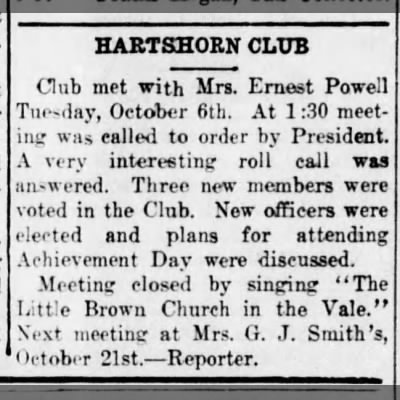
On October 6, 1941, Julia hosted a meeting to add new members and elect officers for the following year. The meeting was closed by singing "The Little Brown Church in the Vale."
16 Oct 1941, The Houston Herald, Page 3


The meeting on October 21, 1941 was opened with a roll call answered with "How to Avoid Home Accidents."  The ladies pieced a quilt for Mrs. Smith, the hostess, and Julia reported on Achievement Day.
30 Oct 1941, Page 7


A training meeting on December 1st, 1941 was held for Extension Club officers, including Mrs. Ernest Powell, Vice-President of Hartshorn Club.
25 Dec 1941, The Houston Herald, Page 6
Articles about the Hartshorn Club continued after this one, but I didn't find another where Julia was mentioned by name. She may have stepped back for a time, or just not been as active, because of so much happening in her family. She had three sons serving in the war, one daughter had just been married and two more soon would be wed. I do know that she stayed involved in the community and maintained many friendships for the rest of her life. My mother once told me that her grandmother Julia's funeral had the highest attendance of any funeral ever held in Hartshorn. That speaks volumes about her character, doesn't it?

Newspaper articles found on Newspapers.com.

Tuesday, January 15, 2019

Nyleta (Powell) Cobb 1926-1987

Nyleta wasn't given a middle name by her parents, Ernest and Julia (Davis) Powell, when she was born on May 1, 1926, in Hartshorn, Texas County, Missouri. She wasn't named after a grandmother, an aunt, or any other family member alive or dead. The name was more common in Australia but very rare at that time in the United States. It makes me wonder how Ernest and Julia, a farming couple from the Ozarks, came up with the name for their second daughter, my maternal grandmother.

Growing up, Nyleta was called by the nickname Tooter. Given to her as a child when she was working really, really hard to learn to whistle, the name stuck with her throughout her life among family and close friends. When I was a little girl, I thought her real name was Tooter because that's all I'd ever heard her called. I discovered her "real" name when I was about 8 or 9 years old. My dad had filled in the simple family tree in the front of my parent's wedding Bible, my first genealogical discovery!

Nyleta (Powell) Cobb, wedding portrait taken in Dec. 1944
My grandparents were married in Kansas City, Missouri in December of 1944. Leroy Cobb was born in 1927 in West Plains, Howell County, Missouri and was only 17 when they were married, requiring the consent of his parents, Kay and Hattie Cobb. Nyleta was 18 and considered "of age". In the Spring of 1945, Leroy enlisted in the Navy. He was discharged a year later and the young couple settled down to begin their family. They lived in downtown Kansas City in a home with Roy's parents. It was there that daughter Louise came in 1947, followed by Julia in 1949, and Ronald in 1952. Nyleta worked some odd jobs during that time to supplement the family income. She packed tomatoes at the City Market and worked for her Uncle Joe Fisher at his downtown restaurant.

Leroy and Nyleta Cobb, about 1950,
at a Cobb family gathering.
In 1956, Leroy and Nyleta bought a home of their own in the Gladstone area of Kansas City. It was a small home, but even after son Randall came that year, it was roomy enough for their family of 6. When I was little, my grandma worked in the Farmland cafeteria. I think it was mostly a cafeteria for the Farmland employees, but I remember going with my mom to have lunch at Grandma's work. She worked there until she retired.

Nyleta Cobb with her daughters, Louise and Julia.
Taken in Hartshorn at her parent's home about 1951.
My grandmother enjoyed having her family near. She loved to host everyone at her house, cooking meals to feed as many as could cram around her big dining room table. In the 1970s and 1980s, three of her four children moved their families out of state. My grandma really hated that her kids were so far away, but the worst was that they took the grandchildren with them. Our family vacations were always to my grandparent's house to visit, and they made trips to see us, too.

Leroy and Nyleta Cobb, 1981
at my parent's house in North Bend, WA
Nyleta was diagnosed with cancer at age 59 and died two years later after a long, tough struggle. She was as special as her name was unusual, and is so fondly remembered by her family.

Tuesday, January 8, 2019

Great Aunt Ernestine - an artist who lost her vision

Edna Ernestine Allen Dvorak (1908-2005) was a daughter, sister, wife, mother, and artist. Born in 1908 in the farming community of Outlook, Washington, Ernestine was immersed in the arts from a young age. To entertain themselves, she and her siblings were encouraged by their parents, Elam and Rena Allen, to be creative. They learned to play instruments, sing, write poetry, draw, and paint. After graduating Salutatorian of her Kiona Benton High School class, Ernestine made the decision to pursue art studies at the Derbyshire School of Fine Arts in Seattle. She also studied poetry writing under the tutelage of Lucile V. McCurtain, publishing several pieces in literary magazines. A charter member of Artists United and a member of the Seahurst Workshop Gallery in Burien, Ernestine created many marvelous paintings and won numerous awards. Ernestine's husband, Don Dvorak, worked behind the scenes in movie theaters, running the projectors to bring the movies to the big screen for viewers. Ernestine and her children were always among the first to see the newest films. It's fair to say that Ernestine's life revolved around the world of art.

Don and Ernestine Dvorak
photo courtesy of Rene Rodgers.

I met my Great Aunt Ernestine only once. My cousin Rene and I arranged a visit to see her in the early 2000's. I don't recall the exact year, but the visit itself is a clear memory. Ernestine gave us a tour of her home, pointing out her artwork as we passed each framed canvas. This tour was from memory; Ernestine was blind. Her sight had faded gradually as she aged due to hereditary glaucoma and she had been blind for many years. When I met her that day, she wore dark glasses and had been listening to the Bible through headphones. There was a stack of religious audiobooks on the table in front of her. It appeared that this was how she now spent much of her time. In her 90s, Great Aunt Ernestine was still sharp as a tack. She shared some stories of her childhood and told me about my grandmother, her younger sister Helen. As a story-teller, she was also a bit of an artist. Adding flourishing details, she animated the tales she told and I can vividly recall them today.

It wasn't long after our visit that Ernestine died. I have often thought of her and the challenge it must have been to lose her eyesight, and with it, her ability to create her beloved paintings. I could still see the pride on her face as she led that tour through her artwork. She could recollect when and where she had painted each one and the awards and recognition that had followed. Newspaper clippings of her accomplishments were lovingly saved in scrapbooks. As Rene and I thumbed through them, Ernestine was following along from memory. When she spoke of her sadness at being forced to give up the hobby she so loved, I said a little prayer asking for my sight to remain until I die.