Friday, April 20, 2018

March 6, 1922 "Rayson have you got the California fever too?"

In this letter, we discover that Rayson is considering a move to California as well. 


Addressed to:
G Rayson Brown.
1468 East 67th St.,
Chicago,
Ill.

From:
E.G. Sisson
Ottawa, Ill.

Ottawa, Ill.
Mar. 6. 1922.

Dear Rayson:

Your most welcome letter received and was surely glad to hear from you so soon. You also are very prompt about answering. And I was just wishing there would be a letter waiting for me but didn't epect such a nice long one.

Rayson have you got the California fever too? How does that happen? Maybe you will there ahead of us at that. I'll tell you it would be a fine to know that at the end of the journey the first person we would see would be an old friend.

Mother and I have been trying to decide whether to sell the property here or just rent it. Suppose we shouldn't care for the country then we could have a home to come to. After all it will be hard for me to leave this little old home, its the only place I have ever lived. But I wouldn't dare say as much to Mother or might decide not to go and as long as its is best for her, I say go.

We are having real spring weather here. Every noon I walk to work and watch the white sea gulls sunning themselves on the ice in the Fox river and it reminds me of the time when we three walked to work so many times together.

Yes Vera wrote finally and said they had both been very sick. Don't tell them I said so but really Rayson they do too much running around, they are always on the go somewhere. They get all worn out and tired and then they take cold. I am awfully glad that they are getting along allright again.

All week I have been sewing. I am making new summer clothes and making over the old ones. I have such a lot of sewing to do before warm weather begins.

The carpenters are putting up the new fixtures at the office and such a noise all the time. Just cannot hear yourself think. It will be a fairly respectable looking place when finished.

Rayson I wouldn't begin to tell you how to have the photo taken because I don't know one uniform from the other. I would rather you would decide that, just whichever you like best. Of course I will send one of mine in return. I like the one like Vera has the best of any of them. And so I will send one just like it.

Well Rayson I must close as it is getting late and I have to get up so early. Write again soon. Best regards to the folks and yourself.

I remain as ever,
Lovingly
Edythe. S.

Thursday, April 19, 2018

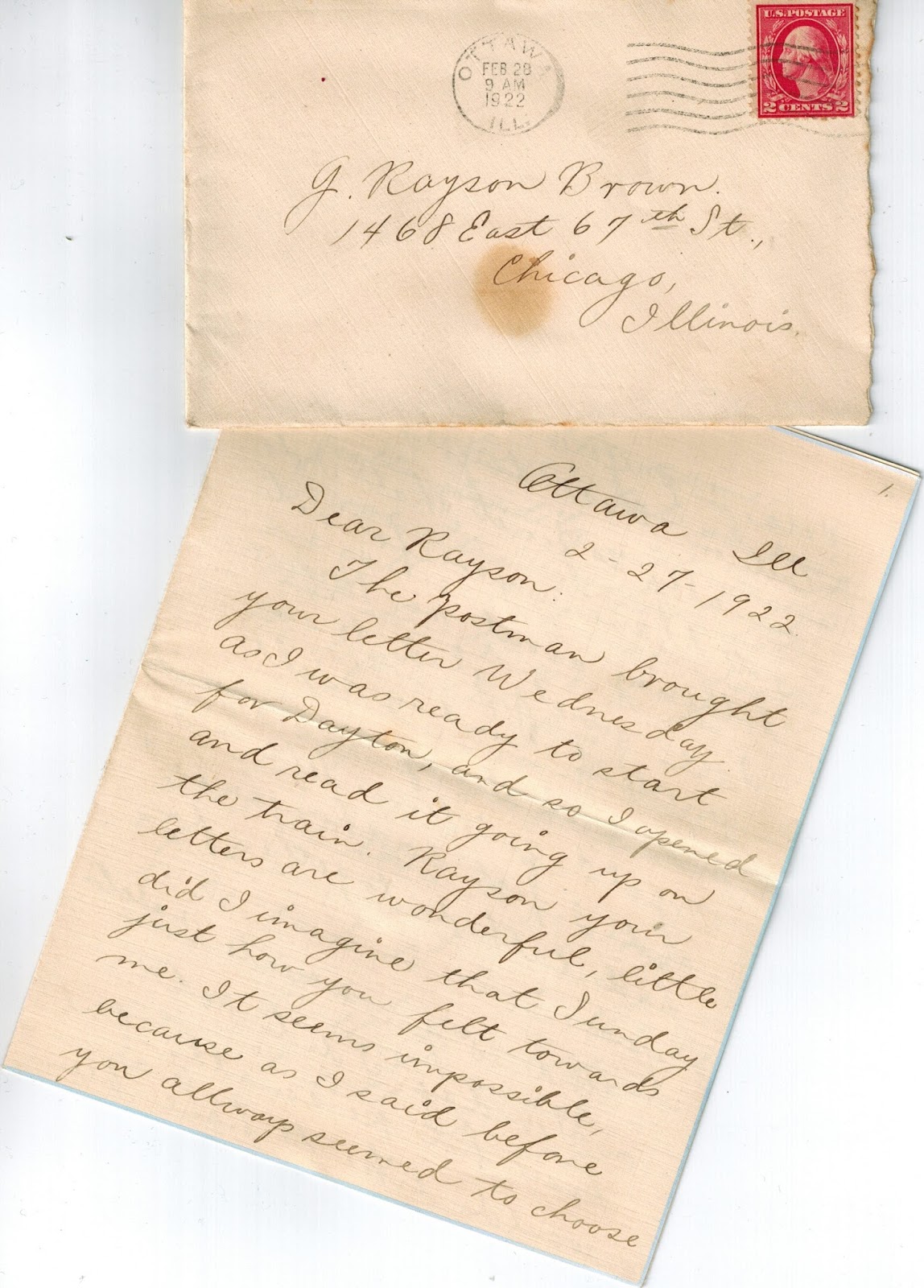
February 27, 1922 A letter with news and photograph request

This letter to Rayson from Edythe mentions Vera, Edythe's sister, and Vera's husband Billy. It seems that they were in Chicago at the same time Rayson was there and they all spent some time together. It also mentions the Masons. Rayson was a 32 degree Mason, known because he also kept all of his Masonic memorabilia. I mentioned before that he was a saver! There is also a bit of gossip in this letter and who can resist some gossip?


Addressed to:
G. Rayson Brown.
1468 East 67th St.,
Chicago,
Illinois.

From (on envelope back):
408 Marcy St.
Ottawa, Ill.

Transcription:

Ottawa Ill
2-27-1922

Dear Rayson:

The postman brought your letter Wednesday as I was ready to start for Dayton, and so I opened and read it going up on the train. Rayson your letters are wonderful, little did I imagine that Sunday just how you felt towards me. It seems impossible, because as I said before you allways seemed to choose Vera in preference to me. But in those days I was usually so quiet that I do not blame anyone for not bothering about me. However I was surely glad to see you that Sunday night and will always remember it. My old quietness left me and I felt as though we had talked together for years.

And so you were to Mabel's on Sunday. I did not know her personally but would like to have been there just the same. Her sister, Isabel is going quite steadily with George Moore. It is rather what we call a bad case. Isn't that it? He works for the express company also.

You must surely have some awfully good times in the Mason's. I wish I could be there to go along. If it were not for having to be back to work I should almost try and go with you Please go though and write and tell me all about it.

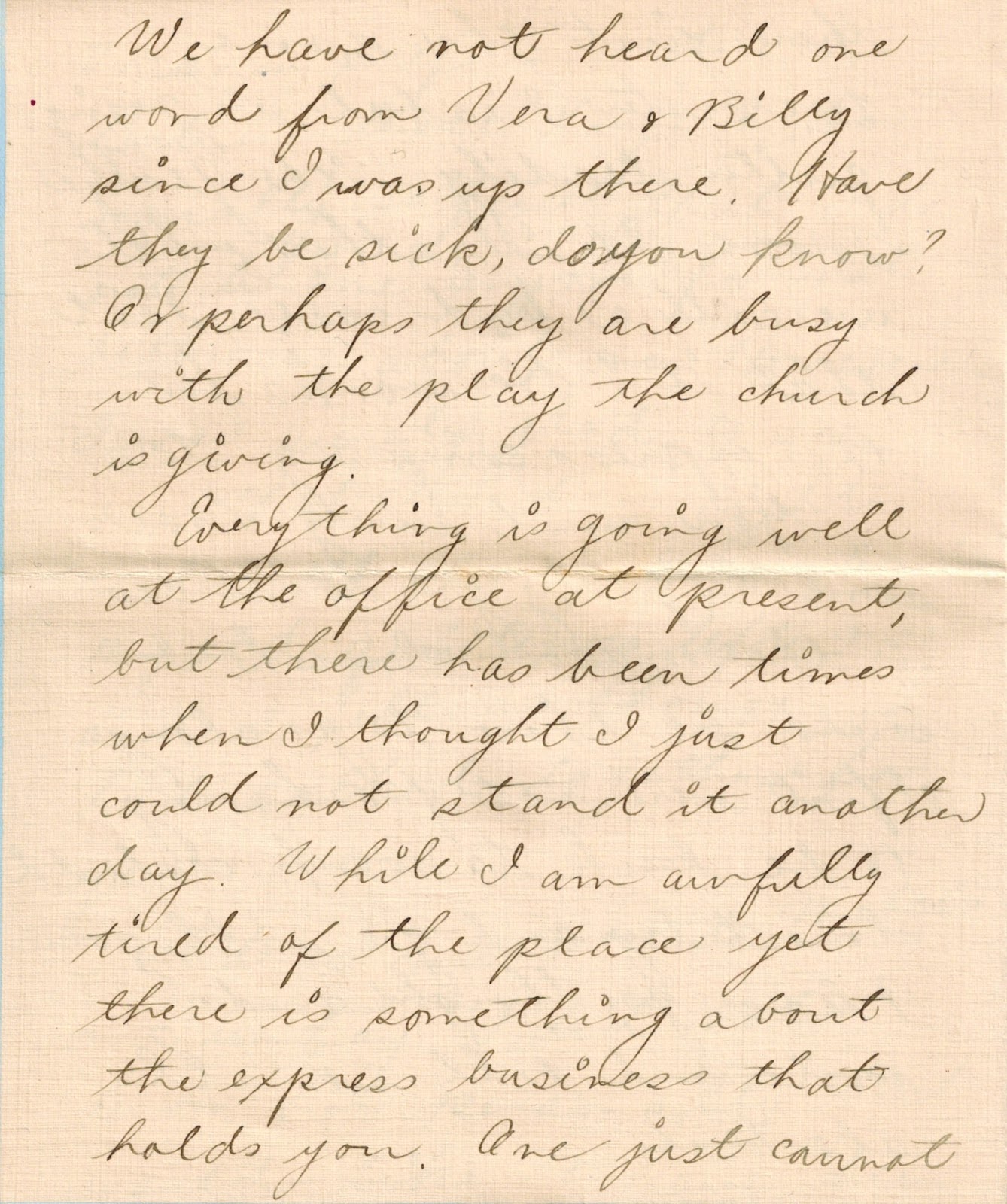
We have not heard on word from Vera & Billy since I was up there. Have they be sick, do you know? Or perhaps they are busy with the play the church is giving.

Everything is going well at the office at present, but there has been times when I thought I just could not stand it another day. While I am awfully tired of the place yet there is something about the express business that holds you. One just cannot seem to get away from it. I am waiting now for an answer from Father and then I will decide whether I stop working the first of April or not.

Rayson, Please do not think I am getting bold, but I really would like to have a photograph of yourself, even just a snap shot if you have one. Please send one if you can.

Vera has evidently been telling you about the tribe I have to work with. Well I will say that some of them try to make life as disagreeable for me as posilbe but I just consider the source and leave it go. After all Rayson it is only a difference in our religion and their belief, for theirs really is not what you would call religion, that causes them to act the way they do. They think we cannot see through them, while it is themselves who are too narrow minded to see. As you say they will all pay up for it sooner or later. I am glad I have some one who thinks of me and my little troubles even though you cannot be here to take my part. It helps a lot if one just has someone to tell all your troubles to.

Well Dear I am going to bring this to a close. I know it is not much of a letter but you have probably noticed by this time that I am not very good at writing letters. Also my writing is very poor, I am so used to writing with a pencil that I just cannot manage a pen anymore.

Write real soon and please spell my name any way you like best, just so I get your letters it will be all right with me.

Sincerely,
Edythe.

Wednesday, April 18, 2018

Duffield/Sisson Postcards No. 50

This card is from a collection of postcards dated between 1908 and 1914 that was found in the Sierra Madre, California home of Warren Brown after his death in 2015. Warren’s mother, Edythe Grace (Sisson) Brown (1897-1978), was the daughter of Edith Amy Duffield (1864-1926) and Charles Herman Sisson (1868-1927). Charles and Edith were married in Ottawa, Illinois in 1895. They remained there until the early 1920s when they moved west to Los Angeles, California. Their collection of memorabilia was passed down to Warren, my husband’s cousin, and is now in my possession.


McKinley Bridge, Peoria, Ill.

Postmarked July 26, 1911 in Peoria, Illinois.

Addressed to:
Chas Sisson
So. Ottawa, Ill.

Peoria July 26, 1911

I am down to see the
motor boat races.
Tee Hee


It's not known who the sender of this card was. I have some writing samples of Edith's that I plan to compare it to but haven't yet. In any case, I found the following article which tells us a bit more about the races:

From The Rock Island Argus, July 25, 1911

PEORIA BOAT RACES ON  
Thousands Gathered for Regatta of Western Association. 
Peoria, July 25. - Traveling toward Peoria in motor boats, automobiles and or, railroad trains are thousands of motor boat enthusiasts who will arrive today for the third annual regatta of the Western Power Boat association. Dozens of fast motor craft are reposing in the Illinois river in preparation for the great speed trials today and tomorrow. Several of the fast racers were given trial spins in the lake Monday afternoon. Speed craft of all sizes and descriptions participated or lined the course during the trials. If weather conditions, including the velocity of the wind, permit, the opening event of the regatta will be started on Peoria lake at 2:30 o'clock this afternoon. The two big races tomorrow will start at 2:30 and 3:30 o'clock respectively with first prize of $I,000 and $100 as the incentive for making fast time. 

February 19, 1922, The first letter to Rayson from Edythe

When Warren Brown passed away, I went with my brother-in-law to help clear out the house. I was in charge of "memorabilia" and oh, boy was there a lot! Warren's parents were G. Rayson Brown and Edythe Grace Sisson. They lived in the home with Warren when they were nearing the end of their lives and all the stuff they brought was still there when Warren died. Rayson was a saver. One of the sweetest finds was a bunch of letters from Edythe and her mother to Rayson prior to their marriage.

Just a bit of background - Edythe's parents were Charles Herman Sisson and Edith Amy Duffield. They had two daughters, Edythe and Vera, and lived in Ottawa, LaSalle County, Illinois. Charles was a carpenter and had made the decision to move west to California. Rayson's parents lived in Ottawa, but Rayson was living and working in Chicago. Edythe was 24 years old, Rayson 23. In these letters, we can see the beginning of their love story.


Addressed to:
G Rayson Brown.
1468 East 67 St.
Chicago
Illinois

From (on the back of the envelope):
408 Marcy St.,
Ottawa, Illinois

Transcription
Ottawa, Ill.,
2-19-1922.

Dear Rayson,

I received your letter and was surely glad to hear from you. This has been a very busy week for me, being away Monday just seemed to put me back all week with my work.
Yes I got home all safe and sound, but all tired out. I took a taxi from the station because it was late and too far to walk.
Clara Gerding came down on the train with me. Do you remember her? She lives just at the top of the East Hill on State St.
This town surely seems unbearable after I am in Chicago for a while. I like the noise and excitement of the city. Here we go along in the same old rut year after year.
The office was all up side down Tuesday morning. The new fixtures came Monday and new counter fills up the whole front office. 
Mother is getting along fine now. It has been such nice weather, she goes for a long walk every day and the fresh air is doing wonders for her.
I like the little church on the corner, every one is so sociable. They make you feel right at home. I was surprised to see so many young men in church. Here the boys all seem afraid of a church.
Well Rayson I must bring this letter to a close as I haven't written to Father for a long time and must do so tonight. Write again soon as I will be looking forward to a letter from you,

Lovingly
Edythe.


Monday, April 16, 2018

#virtualoregontrail April 16, 1845 "Got under way..."

The Riggs' driver, James Field, kept a diary along the way to Oregon. He started it the day they left for St. Joseph. These are his first entries.


Weston, Platte Co., Mo., April 16, ’45. 
-Got under way this day at 12 m. Took the road to St. Joseph; went about 9 miles, and camped. 

17th. – This stay started in the morning; went 22 miles more, and camped about 6 miles below St. Joseph, which is now in sight, situated at the foot of the Missouri bluffs, at the far side of a prairie lying between us and it. 

18th. – Struck off in a different direction to the lower ferry, six miles from us, where we crossed the Missouri about 2 miles from the Emigrant camp, which we joined this evening. There we remained until the 29th, in the afternoon, when, in company with about 80 wagons, we rolled out about 3 miles and formed an encampment in the prairie, for the purpose of herding the cattle as they were collected in from the Missouri bottom, where they were badly scattered, and some never recovered. 

From “The Diary of James Field” Willamette Farmer (Portland, OR, Fridays: April 18 – August 1, 1879). 
18 Apr 1879 (April 16, 1845-May 27) 


Weston, Missouri lies in Platte County, about 40 miles south of St. Joseph. Both cities are situated along the Missouri River. (Side note: I grew up in North Kansas City and lived only 15 miles or so from Weston. I wish I had known about this history then!)

Each week, I'll post the entries from this diary. I'll add supplemental information from other sources when it adds to the story. We're off! I hope you enjoy following along in this virtual journey with my great-great grandfather's family on the Oregon Trail!

Wednesday, April 11, 2018

#virtualoregontrail The Military Immigrant Train

In 1845, at least 2500 emigrants traveled over the Oregon Trail to reach the Oregon Territory. This migration, the largest one to date, nearly doubled the population of the territory. The emigrants joined together in much smaller groups, or companies, who left Missouri over several weeks.

One such group, the Military Immigrant Train, was led by William G. T'Vault. It was one of three groups planning to leave together from St. Joseph. It was under Commander T'Vault that the Riggs and Allen families planned to travel. The T'Vault Military Immigrant Train alone included 66 wagons, almost 300 people, and nearly 1500 head of stock. The two companies joining them would be led by Lawrence McNary and John Herron. These groups were piloted by John Clark, a local trader, who agreed to guide them as far as "Burnett's Trace" - also known as"Independence Road".


William G. T'Vault, 


Companies leaving near the same time were led by Samuel Parker, Samuel Hancock, Presley Welch, A. Hackleton, and Solomon Tetherow. Each company established themselves in an orderly fashion. Perhaps they named their group, and they hired officers and assigned roles. The leaders often included a captain, treasurer, secretary, lieutenants, and others with duties related to hunting, scouting, and safety. Bylaws specifying acceptable conduct on the trail were often adopted. Males of sixteen or older could join a group by agreeing to the constitution and paying an initiation fee of one dollar. Members agreed in advance to the authority of the officers of the company.

In the constitution for one of the groups, an article stated that the majority would rule in all cases, and the men were all held to the Military Law of the United States. Bylaws were more specific. For example, murder was punishable by death, an adulterer would receive 39 lashes on their bare back, and dogs running loose around the camp shall be shot at the discretion of the Captain. The constitutions adopted by the other groups were likely similar.

On this day, April 11, in 1845, the Riggs and Allen families had less than a week remaining to make their final preparations. They would leave their homes on the 16th to join T'Vault and the other companies in St. Joseph and prepare for departure.


Tuesday, March 27, 2018

#virtualoregontrail Saying Goodbye

How do you say goodbye to your family knowing that, by leaving, you may never see them again? In 1845, communicating across the country was difficult. One could mail cards or letters, and at the time, that was really the only option. Think about how spoiled we are today. A family member can decide to move hundreds of miles away, but it's so easy to pick up the phone and hear their voice, or video chat to see their face. Even a visit hundreds of miles away is pretty easy. Imagine if those options weren't available. Goodbye was GOODBYE.

James Allen left his entire family to make the trip to Oregon with his wife, young son, and her family. His parents surely adored baby Cyrus, not yet two years old. Now they had to say goodbye to the toddler and his parents. James would be far away from the trusted counsel of his father and the camaraderie of his brothers, especially William and Andrew, who flanked him in birth order. And he wouldn't just be far away, but far away in a rugged, untamed, dangerous new territory.

James' family in Missouri consisted of his parents, Isaac Allen (1794-1846) and Margaret Boyd Miller Allen (1794-1884), and the following siblings at the time James was preparing to leave:
  • William Thomas Allen (1819-1902), his wife Albina and a year old son
  • Andrew J Allen (1822-1908) and his fiance Charity.
  • Elizabeth C. Allen Jones (1823-1907), her husband Nathaniel and two little boys
  • John Ceton Allen (1825-1889)
  • Thomas Gartner Allen (1827-1897)
  • Rebecca Allen (1829-1906
  • Mary Jane Allen (1831-1873)
  • Josiah Allen (1833-1896)
  • Melissa Ann Allen (1836-1916)
In between the busy times of planning and packing, the Allen family was gathering to spend as much time together as possible before saying their goodbyes. Plans were being made for many of them to make the journey the following year, so there was some hope that they would eventually reunite. Even so, goodbyes are never easy. Though they tried to make the occasions lively and happy, there was a deep sadness in the air. Those were not the only goodbyes to be said. They would also leave neighbors, members of the church congregation, and close friends behind. 

While the farewells would have been painful, there was an undercurrent of excitement as the time to leave drew nearer. A journey across the plains and the mountains, sleeping under the stars, and the prospect of settling the new territory all seemed surreal. There was also much to fear. Raids by Indians and treacherous river crossings were dangers they could face. James and Hannah, at the end of each day, probably had long conversations about their future. This, they knew, was a once in a lifetime opportunity and they must be brave. 

Hannah's father, James B Riggs, was an industrious, prosperous man, and his preparations to move to Oregon with his family were made with meticulous attention to detail.  It’s reported that his wife, Nancy, with eight of their children ranging in age from 20 to 3 were accommodated in 5 wagons – along with household goods, food, tools necessary for building a new home, farming supplies and more.  (Hannah, and her husband James M Allen, with their toddler, would follow in their own separate wagon.)  A wagon needed four to six oxen to pull it, so the task of managing six wagons included attending to a large number of cattle and horses as well as keeping the wagons in good repair.  Last, but not least, each wagon needed a driver.  Although James would have depended on his oldest sons Milton, Rufus, and Marion to assist him in driving the wagons, it was necessary for him to hire a fifth driver.  A teamster by the name of James Field, who was an educated and burly 210-pound young man of twenty-two, was James Riggs’ choice.


Oregon Trail pioneers pass through the sand hills,
painting by William Henry Jackson.
https://www.legendsofamerica.com/we-crossingplains/

A place to sleep and meals with the Riggs family would have been James Field’s pay for the journey - a standard currency during the migration West.  When his duties around the camp were completed at the end of each day, he kept a detailed daily journal.  Today James’ diary is one of the most informative accounts available describing the 1845 journey of the Military Immigrant wagon train which later became known as the “Blue Bucket Gold Train”,  “Meeks Cutoff Train” or “Lost Immigrant Train". 

The mutual respect and friendship that developed between James Riggs and James Field endured long after their arrival in Oregon.  In fact, Field recorded visiting the Riggs family as well as leaving his diary in the care of “Capt. J. B. Riggs” on two separate occasions. It's this diary that we'll follow to recreate the journey these brave pioneers began so many years ago.

(Rene Rodgers contributed content to this post.)